Schmelzenthalpie
Die Schmelzenthalpie (engl. enthalpy of fusion, veraltet auch Schmelzwärme oder Schmelzenergie, wobei letzter Begriff genaugenommen etwas anderes bedeutet, s. u.) bezeichnet die Energiemenge, die benötigt wird, um eine Stoffprobe an ihrem Schmelzpunkt bei konstantem Druck (isobar) zu schmelzen, also vom festen in den flüssigen Aggregatzustand zu überführen.

Die zugeführte Energie wird dazu aufgewendet, anziehende intermolekulare Kräfte zwischen den Teilchen (Atome, Moleküle oder Ionen) der Probe zu überwinden, so dass beim Schmelzen die Geschwindigkeit der Teilchen und damit die Temperatur des Stoffes nicht ansteigen (unendliche Wärmekapazität).
Die Schmelzenthalpie eines Stoffes weist den gleichen Betrag auf wie die Kristallisationsenthalpie, die bei seiner Kristallisation frei wird. Um zu kennzeichnen, dass die Probe (das System) beim Schmelzen Energie aufnimmt und beim Erstarren abgibt/verliert, weist die Schmelzenthalpie ein positives und die Kristallisationsenthalpie ein negatives Vorzeichen auf:

Größen und Einheiten
[Bearbeiten | Quelltext bearbeiten]Schmelzenthalpie
[Bearbeiten | Quelltext bearbeiten]Die Schmelzenthalpie ist eine Energie. Im Internationalen Größensystem (ISQ) hat sie daher die Dimension

und somit im Internationalen Einheitensystem (SI) die kohärente Einheit Joule:[1]
![{\displaystyle \left[H_{\text{fus}}\right]={\frac {\mathrm {kg} \cdot \mathrm {m} ^{2}}{\mathrm {s} ^{2}}}=\mathrm {J} }](https://wikimedia.org/api/rest_v1/media/math/render/svg/b3bbb7443bbfcc6eb5f2f6692a7982d449d9ce92)
Spezifische Schmelzenthalpie
[Bearbeiten | Quelltext bearbeiten]Die zur Schmelzenthalpie gehörige Stoffkonstante ist die spezifische Schmelzenthalpie . Sie ist die Schmelzenthalpie einer Probe des Stoffes, bezogen auf die Masse der Probe:


Sie wird dementsprechend in der Einheit Joule pro Kilogramm angegeben:[1]
![{\displaystyle \left[h_{\text{fus}}\right]={\frac {\mathrm {J} }{\mathrm {kg} }}}](https://wikimedia.org/api/rest_v1/media/math/render/svg/bb587304cf323ed66be393ef6c5976e350de2900)
Molare Schmelzenthalpie
[Bearbeiten | Quelltext bearbeiten]In der Chemie ist statt der spezifischen die molare Schmelzenthalpie gebräuchlich. Sie ist die Schmelzenthalpie, bezogen auf die Stoffmenge :


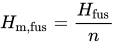
Die Einheit lautet somit Joule pro Mol:[2]
![{\displaystyle \left[H_{\text{m,fus}}\right]={\frac {\mathrm {J} }{\mathrm {mol} }}}](https://wikimedia.org/api/rest_v1/media/math/render/svg/1d4178bb35e18771a9f8498b1f951f4fd5c312b6)
Um bei typischen Stoffen handliche Zahlenwerte zu erhalten, werden die Werte der molaren Schmelzenthalpie gewöhnlich nicht in Joule pro Mol (J/mol), sondern in Kilojoule pro Mol (kJ/mol) angegeben. Beim Rechnen mit molaren Enthalpien in kJ/mol ist zu beachten, dass diese Einheit nicht kohärent ist.
Die spezifische Schmelzenthalpie und die molare Schmelzenthalpie lassen sich mithilfe der molaren Masse [2] des betrachteten Stoffs ineinander umrechnen:

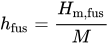
Das von der IUPAC für die molare Schmelzenthalpie empfohlene Größenzeichen lautet abweichend .[3]

Zusammenhang mit der Schmelzenergie
[Bearbeiten | Quelltext bearbeiten]Die Schmelzenthalpie ergibt sich aus der Differenz der Enthalpie des gebildeten flüssigen und der Enthalpie des umgewandelten festen Stoffes:



Analog ergibt sich die Schmelzenergie aus der Differenz deren inneren Energien:

Aufgrund der fundamentalen thermodynamischen Beziehung

ergibt sich damit folgender Zusammenhang zwischen Schmelzenthalpie und -energie:

Siehe auch
[Bearbeiten | Quelltext bearbeiten]Weblinks
[Bearbeiten | Quelltext bearbeiten]- Bestimmen der spezifischen Schmelzwärme von Eis (PDF; 111 kB)
Einzelnachweise
[Bearbeiten | Quelltext bearbeiten]- ↑ a b ISO 80000-5:2007, Quantities and units — Part 5: Thermodynamics, korrigierte Fassung vom 1. Juni 2011.
- ↑ a b ISO 80000-9:2009, Quantities and units — Part 9: Physical chemistry and molecular physics, 1. April 2009. Korrigiert durch: ISO 80000-9:2009/Amd.1:2011, Amendment 1 to ISO 80000-9:2009, 1. Juni 2011.
- ↑ E. R. Cohen, T. Cvitas, J. G. Frey, B. Holmström, K. Kuchitsu, R. Marquardt, I. Mills, F. Pavese, M. Quack, J. Stohner, H. L. Strauss, M. Takami, A. J. Thor: Quantities, Units and Symbols in Physical Chemistry, IUPAC Green Book, 3rd Edition, 2nd Printing, IUPAC & RSC Publishing, Cambridge 2008.