Lichtmenge

aus Wikipedia, der freien Enzyklopädie
Wechseln zu: Navigation, Suche

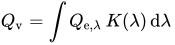
Als Lichtmenge (engl. luminous energy) bezeichnet man in der Photometrie die photometrisch gewichtete Strahlungsenergie, berechnet als Integral des Lichtstroms über der Zeit. Die Lichtenergie wird in der Einheit Lumensekunde (lm s) bzw. Talbot oder Lumberg angegeben.

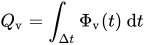
Entsprechend zur Strahlungsenergie bzw. Strahlungsarbeit wird das Produkt aus Lichtstrom Φv und der Zeit t, in der er ausgestrahlt wird, als Lichtmenge oder Lichtarbeit Qv (Einheit: Lumen mal Sekunde) bezeichnet:

Q_\mathrm{v} = \int_{0}^{T} \mathit{\Phi_\mathrm{v}}(t) \mathrm{d}t

[Bearbeiten] Siehe auch

[Bearbeiten] Übersicht über grundlegende Lichtgrößen

Übersicht über photometrische Größen und Einheiten
Bezeichnung Formelzeichen Definition Einheitenname Einheitenumformung Dimension
Lichtstrom
(luminous flux, luminous power)
\textstyle \mathit{\Phi_\mathrm{v}}\,, F\,, P \textstyle \mathit{\Phi_\mathrm{v}} = K_\mathrm{m}\int_{380\,\mathrm{nm}}^{780\,\mathrm{nm}}\frac{\partial\mathit{\Phi_\mathrm{e}}(\lambda)}{\partial \lambda}\cdot V(\lambda)\,\mathrm{d}\lambda Lumen (lm) \textstyle \mathrm{1\, lm = 1\, sr \cdot cd} \mathsf{J} \,
Beleuchtungsstärke
(illuminance)
\textstyle E_\mathrm{v} \, \textstyle E_\mathrm{v}=\frac{\partial \mathit{\Phi_\mathrm{v}}}{\partial A} Lux (lx), früher auch Nox (nx), Phot (ph) \textstyle \mathrm{1\, lx = 1\,\frac{lm}{m^2} = 1\,\frac{sr \cdot cd}{m^2}} \mathsf{L^{-2} \cdot J}
Spezifische Lichtausstrahlung
(luminous emittance)
\textstyle M_\mathrm{v} \, \textstyle M_\mathrm{v}=\frac{\partial \mathit{\Phi_\mathrm{v}}}{\partial A} Lux (lx) \textstyle \mathrm{1\, lx = 1\,\frac{lm}{m^2} = 1\,\frac{sr \cdot cd}{m^2}} \mathsf{L^{-2} \cdot J}
Leuchtdichte
(luminance)
\textstyle L_\mathrm{v} \, \textstyle L_\mathrm{v}=\frac{\partial^2 \mathit{\Phi_\mathrm{v}}}{\partial \Omega \cdot \partial A_1 \cdot \cos \varepsilon_1} keine eigene Einheit, manchmal Nit genannt, früher auch in Stilb (sb), Apostilb (asb), Lambert (la), Blondel \textstyle \mathrm{1\,\frac{cd}{m^2} = 1\,\frac{lm}{sr \cdot m^2}} \mathsf{L^{-2} \cdot J}
Lichtstärke
(luminous intensity)
\textstyle I_\mathrm{v} \, \textstyle I_\mathrm{v}=\frac{\partial\mathit{\Phi_\mathrm{v}}}{\partial\Omega} Candela (cd) (SI-Basiseinheit),
früher auch Hefnerkerze (HK), Internationale Kerze (IK), Neue Kerze (NK)
\textstyle \mathrm{1\, cd = 1\, \frac{lm}{sr}} \mathsf{J} \,
Lichtmenge
(luminous energy)
\textstyle Q_\mathrm{v} \, \textstyle Q_\mathrm{v}= \int_{0}^{T} \mathit{\Phi_\mathrm{v}}(t) \mathrm{d}t Lumensekunde (lm s), Talbot, Lumberg \textstyle \mathrm{1\, lm \cdot s = 1\, sr \cdot cd \cdot s} \mathsf{T \cdot J}
Belichtung
(luminous exposure)
\textstyle H_\mathrm{v} \, \textstyle H_\mathrm{v}= \int_{0}^{T} E_\mathrm{v}(t) \mathrm{d}t Luxsekunde (lx s) \textstyle \mathrm{1\, lx \cdot s = 1\,\frac{lm \cdot s}{m^2} = 1\,\frac{sr \cdot cd \cdot s}{m^2}} \mathsf{L^{-2} \cdot T \cdot J}
Lichtausbeute
(luminous efficacy)
\textstyle \eta\,, \rho\, \textstyle \eta=\frac{\mathit{\Phi_\mathrm{v}}}{P} Lumen / Watt \textstyle \mathrm{1\,\frac{lm}{W} = 1\,\frac{sr \cdot cd \cdot s}{J} = 1\, \frac{sr \cdot cd \cdot s^2}{kg \cdot m^2}} \mathsf{M^{-1} \cdot L^{-2} \cdot T{^3} \cdot J}
Raumwinkel
(solid angle)
\textstyle \Omega \, \textstyle \Omega = \frac{S}{r^2} Steradiant (sr) \textstyle \mathrm{1\, sr = \frac{\left[ Fl\ddot{a}che \right]}{\left[ Radius^2 \right]} = 1\,\frac{m^2}{m^2}} \mathsf{1} \, (Eins)
Meine Werkzeuge
Namensräume
Varianten
Aktionen
Navigation
Mitmachen
Drucken/exportieren
Werkzeuge
In anderen Sprachen