Beleuchtungsstärke
| Physikalische Größe | |||||||
|---|---|---|---|---|---|---|---|
| Name | Beleuchtungsstärke | ||||||
| Formelzeichen | |||||||
| |||||||

Die Beleuchtungsstärke Ev (englisch illuminance)[1] beschreibt den flächenbezogenen Lichtstrom, der auf ein beleuchtetes Objekt trifft. Ihr steht gegenüber die Lichtstärke, die den raumwinkelbezogenen Lichtstrom einer Lichtquelle beschreibt.
Die SI-Einheit der Beleuchtungsstärke ist das Lux (lx, von lateinisch lux, Licht).
Ein verwandter Begriff ist die Lichtstromdichte, die Flächendichte des Lichtstroms durch ein senkrecht zur Strahlrichtung stehendes Flächenelement.[2]
Definition[Bearbeiten | Quelltext bearbeiten]

Fällt auf eine gleichmäßig beleuchtete Fläche der Lichtstrom , so ist die Beleuchtungsstärke auf der Fläche gleich dem Quotienten aus dem auftreffenden Lichtstrom und der Fläche :[1][3]


Variiert die Beleuchtungsstärke über die Fläche, so liefert diese mathematisch vereinfachte Formel die über die Fläche gemittelte Beleuchtungsstärke. Soll die örtliche Variation der Beleuchtungsstärke detailliert beschrieben werden, so erhält man durch Übergang zum Differentialquotienten:[3]

Maßeinheiten[Bearbeiten | Quelltext bearbeiten]
Die Beleuchtungsstärke wird in der SI-Einheit Lux (lx) gemessen, die definiert ist als Lumen durch Quadratmeter (1 lx = 1 lm/m2 = (cd sr)/m2). Ein Lichtstrom von 1 lm, der sich gleichförmig über eine Fläche von 1 m2 verteilt, bewirkt dort also eine Beleuchtungsstärke von 1 lx.

Im angloamerikanischen Maßsystem, insbesondere im nordamerikanischen Raum, verwendet man auch die Einheit Foot-candle (fc), gleichbedeutend mit Lumen durch Quadratfuß. 1 fc entspricht etwa 10,764 lux.
Die Einheit Phot (ph) aus dem CGS-Einheitensystem mit der Definition 1 ph = 1 lm/cm2 = 104 lx ist nicht mehr im Gebrauch.
Photometrisches Entfernungsgesetz[Bearbeiten | Quelltext bearbeiten]
Die Lichtstärke einer als punktförmig angenommenen Lichtquelle ist definiert als Quotient aus dem emittierten Lichtstrom und dem Raumwinkel, in den das Licht ausgestrahlt wird. Das Raumwinkelelement wiederum ist der Quotient aus einem Flächenelement im Abstand und dem Quadrat dieses Abstands. Somit gilt:


- .
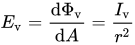
Berücksichtigt man noch die Möglichkeit, dass die Empfangsfläche um den Winkel gegen die Einstrahlrichtung geneigt sein kann ( ist der Winkel zwischen der Flächennormalen und der Strahlungsrichtung), so erhält man das photometrische Entfernungsgesetz:[3]

- .
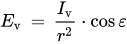
Das photometrische Entfernungsgesetz sagt also aus, dass die Beleuchtungsstärke mit dem Quadrat der Entfernung zwischen Lichtquelle und beleuchteter Fläche abnimmt. Bei Verdoppelung der Beleuchtungsdistanz werden demnach viermal so viele Leuchten benötigt, damit die gleiche Beleuchtungsstärke erzielt wird.
Die Einheit der Lichtstärke, die Candela ist definiert als 1 cd = 1 lm/sr. Emittiert eine Lichtquelle also Licht der Lichtstärke 1 cd in Richtung einer Empfangsfläche, die in 1 m Entfernung senkrecht zur Strahlrichtung steht, so erzeugt sie dort die Beleuchtungsstärke 1 lx.
In der Beleuchtungspraxis sind meist flächenhafte Lichtquellen anzutreffen. Hier müssen aufwändigere, vom photometrischen Grundgesetz ausgehende oder mit Sichtfaktoren arbeitende Rechenverfahren benutzt werden, welche über die von der Leuchtfläche ausgehende und die auf der Empfangsfläche eintreffende Leuchtdichteverteilung integrieren.
Beleuchtungsstärken in der Praxis[Bearbeiten | Quelltext bearbeiten]
Messung[Bearbeiten | Quelltext bearbeiten]

Die Beleuchtungsstärke ist die photometrische Entsprechung zur radiometrischen Größe Bestrahlungsstärke (gemessen in Watt durch Quadratmeter, W/m2). Fällt elektromagnetische Strahlung auf die Empfangsfläche und erzeugt dort die Bestrahlungsstärke , so lässt sich messtechnisch oder rechnerisch die von dieser Strahlung verursachte Beleuchtungsstärke in Lux (= Lumen durch Quadratmeter) ermitteln, indem die einzelnen Wellenlängen der Strahlung mit dem jeweiligen photometrischen Strahlungsäquivalent der betreffenden Wellenlänge gewichtet werden, das die Empfindlichkeit des Auges beschreibt.

Die Beleuchtungsstärke wird mit einem Luxmeter gemessen. An der Physikalisch-Technischen Bundesanstalt (PTB) können Beleuchtungsstärken zwischen 0,001 lx und 100.000 lx realisiert werden.[4] Dies dient u. a. der Kalibrierung von Beleuchtungsstärkemessgeräten.
Normativ geforderte Beleuchtungsstärken[Bearbeiten | Quelltext bearbeiten]
Soll-Beleuchtungsstärken:
- Sicherheitsbeleuchtung von Fluchtwegen: minimale Beleuchtungsstärke mindestens 1 Lux[5]
- Arbeitsstätten je nach Arbeitsraum, -platz und Tätigkeit (innen und im Freien) gemäß Anhang 1 der ASR A3.4[6]
Beispiele typischer Beleuchtungsstärken[Bearbeiten | Quelltext bearbeiten]
| 5 mW Laserpointer, grün (532 nm), 3 mm Strahldurchmesser | 427.000 lx |
| Moderne Operationssaalbeleuchtung, 3500 K | 160.000 lx |
| klarer Himmel und Sonne im Zenit[7] | 130.000 lx |
| 5 mW Laserpointer, rot (635 nm), 3 mm Strahldurchmesser | 105.000 lx |
| klarer Himmel, Sonnenhöhe 60° (Mitteleuropa mittags im Sommer)[8] Beiträge: Sonne = 70.000 lx, Himmelslicht = 20.000 lx |
90.000 lx |
| klarer Himmel, Sonnenhöhe 16° (Mitteleuropa mittags im Winter)[8] Beiträge: Sonne = 8.000 lx, Himmelslicht = 12.000 lx |
20.000 lx |
| bedeckter Himmel, Sonnenhöhe 60° (mittags im Sommer)[8] | 19.000 lx |
| Mindestanforderung für dentale Behandlungsleuchten[9] | 15.000 lx |
| Im Schatten im Sommer | 10.000 lx |
| bedeckter Himmel, Sonnenhöhe 16° (mittags im Winter)[8] | 6.000 lx |
| Bedeckter Wintertag | 3.500 lx |
| Fußballstadion Kategorie 4 (Elite-Fußballstadion) | 1.400 lx |
| Beleuchtung TV-Studio | 1.000 lx |
| Dämmerung (Sonne knapp unter Horizont)[7] | 750 lx |
| Büro-/Zimmerbeleuchtung | 500 lx |
| Flurbeleuchtung | 100 lx |
| Wohnzimmer[10] | 50 lx |
| Straßenbeleuchtung | 10 lx |
| Dämmerung (Sonne 6° unter Horizont)[7] | 3 lx |
| Kerze ca. 1 Meter entfernt | 1 lx |
| Vollmond im Zenit, mittlerer Erdabstand[7] | 0,27 lx |
| Vollmondnacht[11] | 0,05–0,36 lx |
| Halbmond in 45° Höhe, mittlerer Erdabstand[7] | 0,02 lx |
| Sternenlicht und Airglow[7] | 0,002 lx |
| Sternklarer Nachthimmel (Neumond) | 0,001 lx |
| Sternenlicht[7] | 220 μlx |
| Bewölkter Nachthimmel ohne Mond und Fremdlichter | 130 μlx |
| Sirius im Zenit[12] | 8 μlx |
Rechenbeispiele[Bearbeiten | Quelltext bearbeiten]
Beleuchtungsstärke einer Kerze[Bearbeiten | Quelltext bearbeiten]
Die Lichtstärke einer Kerze beträgt etwa eine Candela (1 cd = 1 lm/sr). Sie erzeugt im Abstand von 2 m auf einer senkrecht zur Strahlrichtung stehenden Empfangsfläche die Beleuchtungsstärke
- .

Von einer Kerze im Abstand von ca. 2 m senkrecht beleuchtete Gegenstände erscheinen also ungefähr so hell beleuchtet wie im senkrecht auftreffenden Licht des Vollmonds.
Lichtstrom und Lichtstärke einer isotrop strahlenden Lichtquelle[Bearbeiten | Quelltext bearbeiten]
Die Beleuchtungsstärke , die von einer isotrop strahlenden Lichtquelle auf einer in 3 m Abstand senkrecht zur Strahlrichtung stehenden Empfangsfläche erzeugt wird, betrage
- .

Nach dem photometrischen Entfernungsgesetz ergibt sich daraus für die Lichtquelle eine Lichtstärke

Über den vollen Raumwinkel von 4π sr integriert errechnet sich der von der Lichtquelle erzeugte Lichtstrom zu
- .

Esszimmertisch[Bearbeiten | Quelltext bearbeiten]
An der Decke befindet sich eine kleine, praktisch punktförmige Lichtquelle, die den Lichtstrom Φv= 3000 Lumen isotrop in einen kegelförmigen Bereich mit dem Öffnungswinkel α = 160° abgibt. Welche Beleuchtungsstärken erzeugt sie auf der r = 1,67 m tiefer liegenden Tischplatte
- in Punkt A, der senkrecht unter der Lichtquelle liegt und
- in Punkt B, der ebenfalls auf der Tischplatte, aber d = 1,15 m neben Punkt A liegt?
Der Öffnungswinkel von 160° entspricht einem Raumwinkel von . Da die Lichtquelle isotrop strahlt, ist die Lichtstärke in allen Richtungen des beleuchteten Halbraums dieselbe und beträgt:

- .

Da die Lichtquelle als punktförmig vorausgesetzt ist, kann zur Berechnung der Beleuchtungsstärke das photometrische Entfernungsgesetz angewendet werden. Für Punkt A ist die Entfernung r = 1,67 m und der Einfallswinkel ε = 0°, also
- .

Für Punkt B beträgt die Entfernung zur Lichtquelle (Satz des Pythagoras):

und der Einfallswinkel ist:

Hieraus ergibt sich:
- .

Zusammenhang mit radiometrischen und anderen photometrische Größen[Bearbeiten | Quelltext bearbeiten]
| radiometrische Größe | Symbola) | SI-Einheit | Beschreibung | photometrische Entsprechungb) | Symbol | SI-Einheit |
| Strahlungsfluss Strahlungsleistung, radiant flux, radiant power |
W (Watt) |
Strahlungsenergie durch Zeit | Lichtstrom luminous flux |
lm (Lumen) | ||
| Strahlstärke Strahlungsstärke, radiant intensity |
W/sr | Strahlungsfluss durch Raumwinkel | Lichtstärke luminous intensity |
cd = lm/sr (Candela) | ||
| Bestrahlungsstärke irradiance |
W/m2 | Strahlungsfluss durch Empfängerfläche | Beleuchtungsstärke illuminance |
lx = lm/m2 (Lux) | ||
| Spezifische Ausstrahlung Ausstrahlungsstromdichte, radiant exitance |
W/m2 | Strahlungsfluss durch Senderfläche | Spezifische Lichtausstrahlung luminous exitance |
lm/m2 | ||
| Strahldichte Strahlungsdichte, Radianz, radiance |
W/m2sr | Strahlstärke durch effektive Senderfläche | Leuchtdichte luminance |
cd/m2 | ||
| Strahlungsenergie Strahlungsmenge, radiant energy |
J (Joule) |
durch Strahlung übertragene Energie | Lichtmenge luminous energy |
lm·s | ||
| Bestrahlung Einstrahlung, radiant exposure |
J/m2 | Strahlungsenergie durch Empfängerfläche | Belichtung luminous exposure |
lx·s | ||
| Strahlungsausbeute radiant efficiency |
1 | Strahlungsfluss durch aufgenommene (meist elektrische) Leistung | Lichtausbeute (overall) luminous efficacy |
lm/W |


Siehe auch[Bearbeiten | Quelltext bearbeiten]
Literatur[Bearbeiten | Quelltext bearbeiten]
- Hans R. Ris: Beleuchtungstechnik für Praktiker. 2. Auflage. VDE-Verlag, Berlin/Offenbach 1997, ISBN 3-8007-2163-5.
- Horst Stöcker: Taschenbuch der Physik. 4. Auflage. Verlag Harry Deutsch, Frankfurt am Main 2000, ISBN 3-8171-1628-4.
Einzelnachweise[Bearbeiten | Quelltext bearbeiten]
- ↑ a b International Electrotechnical Commission (IEC): International Electrotechnical Vocabulary. ref. 845-21-060, illuminance (abgerufen am 19. Juli 2021).
- ↑ Lexikon der Physik, Spektrum
- ↑ a b c DIN 5031 Strahlungsphysik im optischen Bereich und Lichttechnik. Teil 3: Größen, Formelzeichen und Einheiten der Lichttechnik. Beuth, Berlin 1982.
- ↑ Messung von Licht.Photometrie. Physikalisch-Technische Bundesanstalt, S. 15.
- ↑ Ausschuss für Arbeitsstätten: ASR A3.4/7 Sicherheitsbeleuchtung, optische Sicherheitsleitsysteme. BAuA, abgerufen am 18. Februar 2019.
- ↑ publisher: BAuA - Technischer Arbeitsschutz (inkl. Technische Regeln) - ASR A3.4 Beleuchtung - Bundesanstalt für Arbeitsschutz und Arbeitsmedizin. Abgerufen am 18. Februar 2019.
- ↑ a b c d e f g P. K. Seidelmann (Hrsg.): Explanatory Supplement to the Astronomical Almanac. University Science Books, Mill Valley 1992, ISBN 0-935702-68-7, S. 493.
- ↑ a b c d DIN 5034 Tageslicht in Innenräumen. Teil 2: Grundlagen. Beuth, Berlin 1985.
- ↑ ISO 9680 Zahnheilkunde – Behandlungsleuchten
- ↑ Alan Pears: Strategic Study of Household Energy and Greenhouse Issues. Australian Greenhouse Office, Juni 1998, Chapter 7: Appliance technologies and scope for emission reduction, S. 61 (archive.org [PDF]).
- ↑ Christopher C M Kyba, Andrej Mohar, Thomas Posch: How bright is moonlight? In: Astronomy & Geophysics. Band 58, Nr. 1, 1. Februar 2017, S. 1.31–1.32, doi:10.1093/astrogeo/atx025.
- ↑ Helligkeit des Sirius von −1,46 mag eingesetzt in die Formel aus: Jean Dufay: Introduction to Astrophysics: The Stars. Dover Publications, 1964, ISBN 978-0-486-60771-9 (eingeschränkte Vorschau in der Google-Buchsuche [abgerufen am 4. November 2019]).; siehe auch Scheinbare Helligkeit#Beleuchtungsstärke
